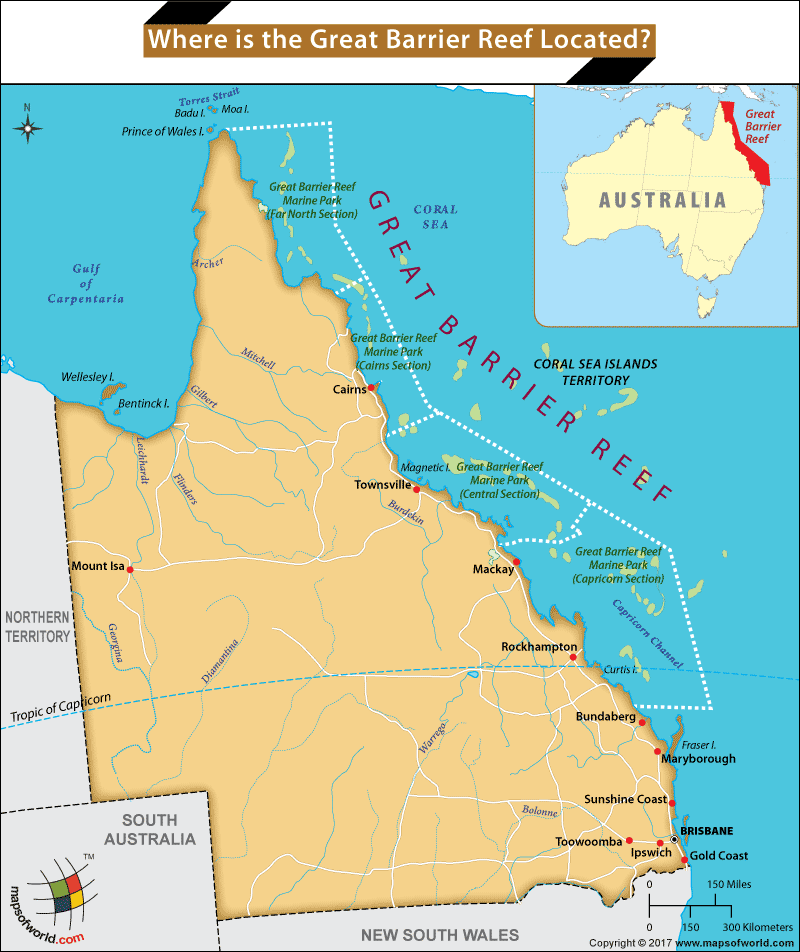
The Great Barrier Reef is truly one of the great natural wonders of the world. Comprising of almost 3,000 separate reefs and 900 separate island, it stretches for 1,500 miles along the coast of northeastern Australia and is the largest reef system in the world. It is so large, in fact, it can be seen from space. Because coral reefs are made from tiny living polyps, the Great Barrier Reef is also considered the largest structure on Earth made by living organisms.
But how did it come to be?
Basically, when the Earth was coming out of its last ice age around 10,000 years ago, the seas began to rise over Australia’s islands and shallow eastern coastline. Tiny limestone skeletons of polyps began to form and grow, creating the extensive and diverse reefs that still exist across these shallow waters. Some of the coral is estimated to be 6-8,000 years old.
Of course, the Great Barrier Reef is a UNESCO World Heritage Site and favorite destination of travelers from around the world. That said, I hadn’t originally planned on coming this far north to fully experience the reef. But this past year, one of my Alaska passengers was from Australia, and told me that missing the reef would be a huge mistake. So, I changed plans and flew up from Sydney to Cairns, Queensland, a major jumping-off point for the Great Barrier Reef.
Cairns (pronounced in Aussie fashion as “Cans”) is a nice town, complete with a large, salt-water pool and oodles of diving and snorkeling tours heading out to the reef.


After reserving a day-long multiple-stop snorkeling experience, I headed to the local aquarium to learn more about what I was going to see. I learned that reefs occupy only 1% of the ocean floor, but are home to 25% of all marine life in the world. I also came to understand that the Great Barrier Reef is the largest and most diverse reef ecosystem in the world. Thanks to the exhibits, I learned that corals were actually animals and that the reef is made up of hard corals and soft corals. I also tried to remember to look for plants such as algae and seagrass as well as crustaceans, mollusks, jellyfish, sponges, sea anemones and of course the many different species of fish that inhabit the reef, too.
But truth be told, I just tried hard not to think about all the things that could sting and eat me down there! I shouldn’t have been too worried. When I first stuck my head in the water, I thought I was swimming in a National Geographic film. It was calm and beautiful.

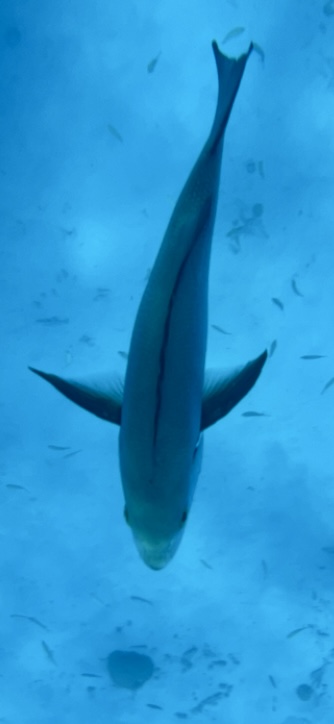


Even though visibility was stellar, I need to acknowledge that for the first time, my little I-Phone 12-Mini did not serve me well. And the fiddly plastic waterproof case wasn’t helping either as I couldn’t really see what I capturing. I just swam around, marveling at the scene, aiming the camera and hoping that I would be able to discern something in these photos. Sadly, not so much. My memories are much more vivid!
But as you look at these photographs, I encourage you to zoom in a little and really look at the textures I was trying to capture. I’ve been snorkeling in some amazing places where I’ve had thousands of fish schooling around my head. But on this day, in the Great Barrier Reef, it was less about the fish and more about the corals.
Of course, there were many more fish than what I captured with my camera… a loggerhead turtle and a reef shark, too! But after going to the aquarium and learning about all the non-swimming animals and plants that wedge themselves in amongst the corals, I was mesmerized at all the textures, colors and life in every square inch. It was breathtaking!


Look again at the middle photo in the bottom row- that’s a giant clam just waiting to open! Once I knew what I was looking for, I saw them everywhere in the depths. It really was an amazing experience to be in the Great Barrier Reef.