The stark, high-elevation region of northern Chile and southern Bolivia have always fascinated me. In my last trip across southern South America, I got a glimpse of the “altiplano” as my bus crossed over a 16,000 foot pass between Chile and Argentina. The light, the desolation and the thin air captivated me. I didn’t have time then, but I promised myself that someday I’d come back for more. On this trip, I’m here for more.
The easiest way to explore the altiplano, or high-elevation plateau, in central South America is to spend some days in southern Bolivia. This year, after a quick stop in Argentina, I took a bus through an incredible geologic maze to the northern border and then walked into Bolivia, finding a bus on the other side.


I was heading for Tupiza, a small community with a reputation for quality 4-day 4×4 tours across the altiplano of Southwest Bolivia. After comparing companies, I laid down my money with La Torre Tours, and with two other couples we were off on our adventure!
Our 4 Day, 3 Night Tour Begins
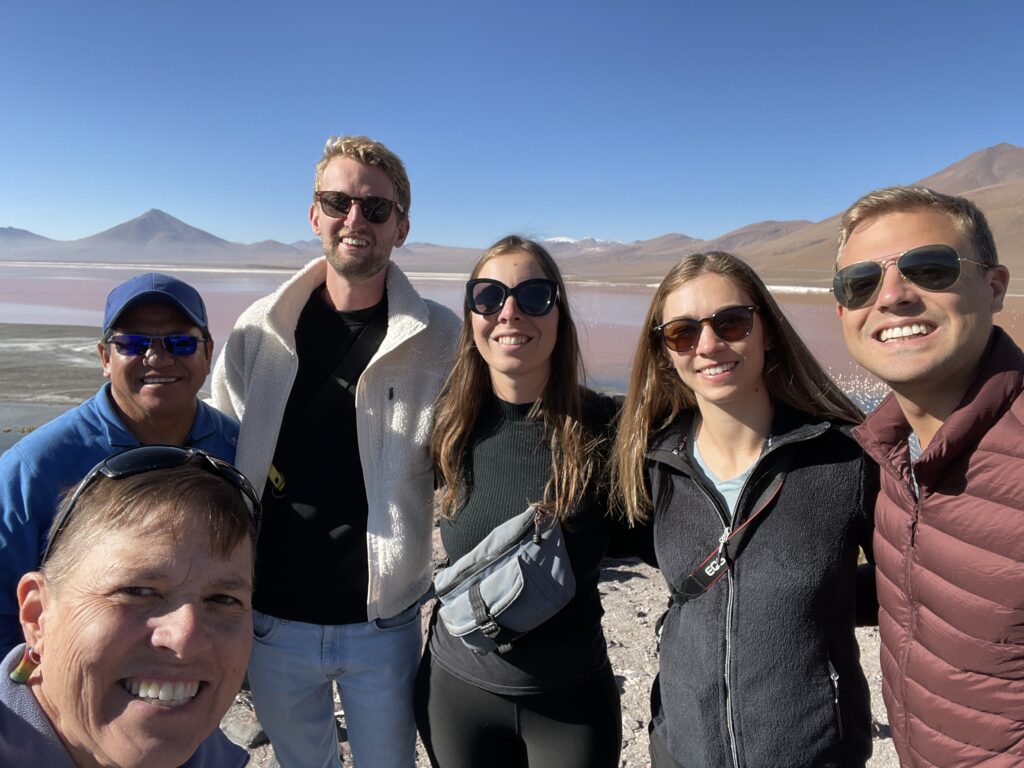
Raúl (our guide) with Max and Clarisse from France, and Chrisy and Lukas from Germany


Thank goodness for Raúl, our trusted driver and guide. With over 15 years of experience guiding in this region, he kept us safe across the maze of tracks and a variety of road conditions! And if you’re getting a Butch Cassidy and Sundance vibe… yup, this is the region where they robbed some trains and had their final shoot-out, too. Although that wasn’t part of our tour.
Reserva Nacional Eduardo Avaroa
For the first day, we had a long drive across the altiplano. We were heading up, up, up into the Reserva Nacional Eduardo Avaroa, the largest National Park in Bolivia. On this first day, we reached around 16,000 feet, or 4,800 meters above sea level. (MSNM = Metros Sobre el Nivel del Mar)


Along the way, we stopped for lunch, and to rest for the night, in some very small, isolated and windswept communities.


Altiplano Communities
The communities that exist across this high-altitude, arid region rely on raising llamas (for wool and meat), sheep (for wool and meat), and goats (for milk and meat). Others cultivate quinoa. Some also work in tourism in small hotels with restaurants, or as local drivers and guides. A very few are selling supplies in small stores. Others might work for the government in the national parks, or for local companies that are harvesting salt. Local and international companies that are also mining in the region. Predominantly, however, the inhabitants are extremely poor.
Let’s learn more about some forms of life in the altiplano of Bolivia!
Llamas, Llamas Everywhere!
Llamas are a camelid, and were domesticated by the Indigenous well over 4,000 years ago, making them one of the oldest domesticated animals in the Americas. Historically, they had been used as pack animals, but with the modern age of trucking, they are mostly raised now for their thick, course fiber. Their wool comes naturally in white, black, brown and beige colors, with white being the most highly valued. Therefore, herders try to genetically cross breed their llamas to achieve more white colors.
Interestingly, llamas have high hemoglobin levels which means that they thrive in low-oxygen, high-altitude environments. They survive by eating all kinds of grasses, thorny plants and tough foliage which is so prominent in this harsh South American environment. Mama llamas -that’s fun to say!- have one baby each year. They live and produce wool for about 10 years before they’re slaughtered for their meat called charqui.
We saw hundreds of llamas roaming across the hillsides, most with their easily identifiable colored yarn tassels decorating their ears. Families choose two distinct colors to mark their llamas so that everyone else in the community knows whose llama is whose. Wild pumas do roam this landscape and occasionally kill a llama, but apparently not frequently enough to keep the llamas in their pens.


I’m not sure why I don’t have any pictures of llamas with their tassled ears! But I do have a video of them running by!
Do you eat Quinoa (keen-wah)? It is considered a “superfood” because it is so good for you. Quinoa is a naturally gluten-free grain that is a good source of protein and fiber. It is rich in antioxidants and many minerals with high levels of several B and E vitamins.
Quinoa has been cultivated in this region of South America for more than 4,000 years and is still a prominent food source for the Quechua and Aymara people, which are descendants of the Incas.
There are hundreds of types of quinoa around the world, and more than 50 types are cultivated in the altiplano of Bolivia. It is estimated that in Bolivia over 70,000 small-land farmers are growing large grain “Quinoa Real” and exporting it to the US, Netherlands, France and Germany. The most superior and commercialized types you might see in your stores are White, Red and Black.
Clearly, the production of quinoa is a vital part of this economy!


I didn’t get any photos of this, but as Quinoa reaches maturity (after 3-4 months) and is ready to harvest, the seeds and leaves change to beautiful colors of reds, purples, oranges and magentas.
Out in this desolate region, there were a few other forms of life as well. We definitely saw some birds, and lizards. But the most prominent animal strolling the mountainsides and valleys were the vicuñas.
Vicuñas
Vicuñas are a wild camelid that thrives throughout the Andes Mountains. In Bolivia, and many other countries, they are a protected species. Their fur, however, is lighter and more cinnamon-colored than a llama and it is very fine, giving it a higher value on the textile market. So, as our guide told us, some people capture the vicuñas to shave their fur and then let them go again.
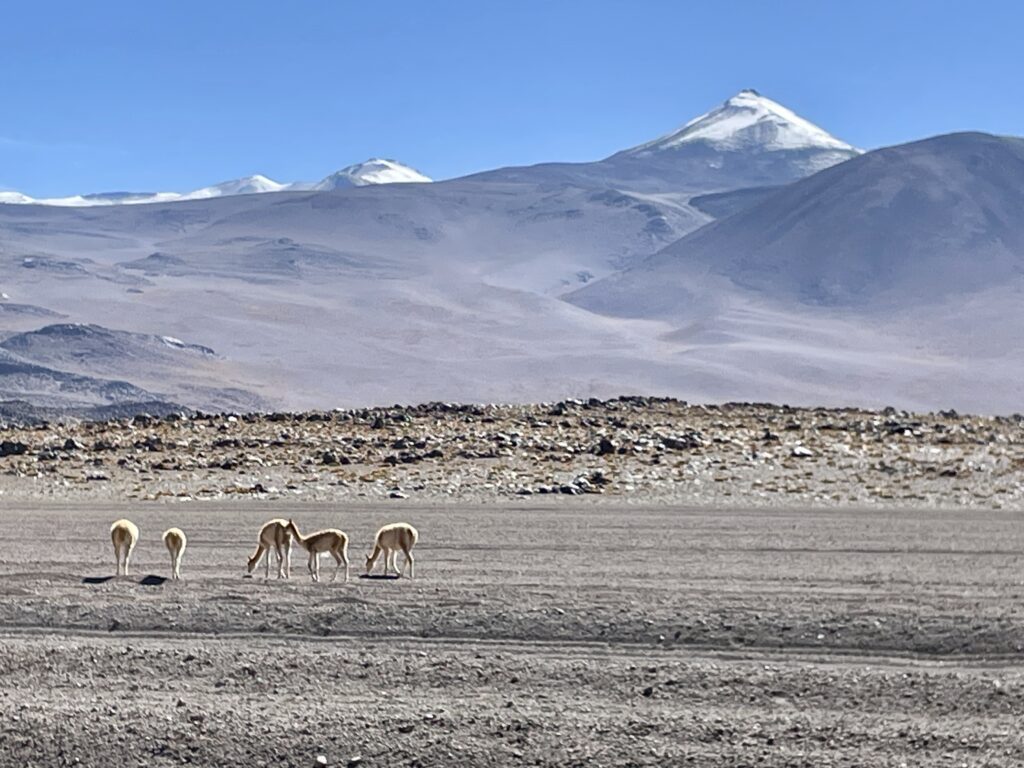
Vicuñas are very agile and fast. They have a long neck, slender body and long legs, giving a graceful profile as they sprinted away from our approaching car. We saw hundreds, but I never got a great photo of any of them.
The other prominent animal we saw along the tour was flamingos!
Flamingos? Yes! In the Altiplano Lagoons
The high-altitude lagoons of Reserva Nacional Eduardo Avaroa provide habitat for three types of flamingos: the Chilean, Andean and James Flamingos. Living out their summer at over 13,000 feet, the flamingos feed on the algae in these mineral rich waters. During the winter, when these lagoons freeze, the flamingos fly across the Andes Mountains to feed in the lower elevation lagoons within the Chilean Atacama Desert. I wrote about the Atacama Desert on my adventure through the region in 2023.


Ok, so sometimes the flamingos were really far away. But I promise, they were out there!
The Geology of the Altiplano
The Lagoons pictured above are aptly named Laguna Verde (Green), Laguna Blanca (White) and Laguna Colorado (Red). What gives these lagoons their unique colors? First, you have to know that this entire area was once much lower and under sea water. Many of the sedimentary rocks display fossils and some of the rocks originate from coral. So, as the land was pushed up (by forces of tectonic plates) and blown up (by volcanos), a variety of minerals concentrated in the low pools of water. Sodium chloride (salt), boron, magnesium, potassium and sulfur are the most common minerals in this area. The lakes displaying green, white or red colors also contain arsenic, copper, gypsum and lead. And of course, international investors are discovering a grand reserve of lithium underlying it all, too.
Geysers, Mud Pools and Hot Springs, Oh My!
Other examples of geologic activity across the altiplano is the presence of geysers, fumaroles and mud pools. We could really smell the sulfur here!


In other areas, there was a lot of steaming hot water coming from the ground and flowing into the lagoons. One afternoon, we got to swim in the hot springs Aguas Termales de Polques on the edge of Chalviri Lagoon.


Our tour through this region was jam-packed with mega-landscapes, harsh habitats and so much to learn. Raúl did an amazing job keeping us on-track, well-slept, and well-fed with picnics throughout the adventure.


But that’s not the whole story. Raúl drove incredibly fast, careening across the sand and gravel landscapes guided only by faint tire tracks or a feature on the horizon. The angled light set distant hills aglow adding color to the many lagoons and grasslands we flew by. Our pace gave us only an opportunity to quickly glance at a brick house built not far from the road with hand-set stone corrals waiting for their llamas to come home. A lone person stood out front, leaning against the constant wind blowing across the plains. We squinted into the glaring sunlight to see dust rising in the distance – another vehicle coming our way. A pack of vicuñas eating alongside the road suddenly jumped to a sprint as they raced alongside our truck and veered off into the hills. There, a fleeting glimpse of a flamingo at water’s edge, and another bird dipping from the vast blue sky. All the while, the deafening silence of the Bolivian altiplano was being interrupted by the blaring music from the truck’s stereo. A self-professed hater of traditional Bolivian music, Raúl only played international pop songs with a heavy preference for Katy Perry. It was definitely a tour for the senses.
And that was only the first two days!
Stay tuned for the second part of our tour where we explored the famous salt flats of Bolivia; the Salar de Uyuni.