
I know so many people who have experienced the wonders of Costa Rica, but for me, it had never been high on my list. But this year, as I’m making my way south through a variety of countries, I decided I should check out the nature of Costa Rica. What I found is that Costa Rica is literally bursting with life!
Like all of Central America, Costa Rica is sandwiched between two continents and two oceans and has been the mixing bowl for thousands of plants and animal species. The country’s name “Rich Coast” was actually given to this region by the Spanish explorers who assumed Costa Rica was filled with gold. The “gold” turned out to be the green kind, as this country is rich in biodiversity and natural beauty.
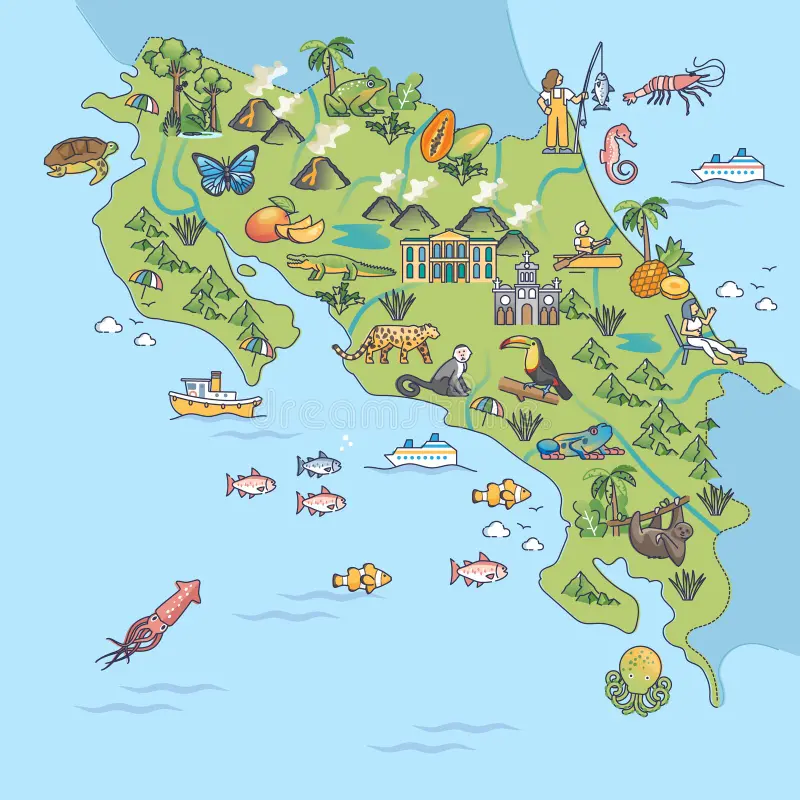
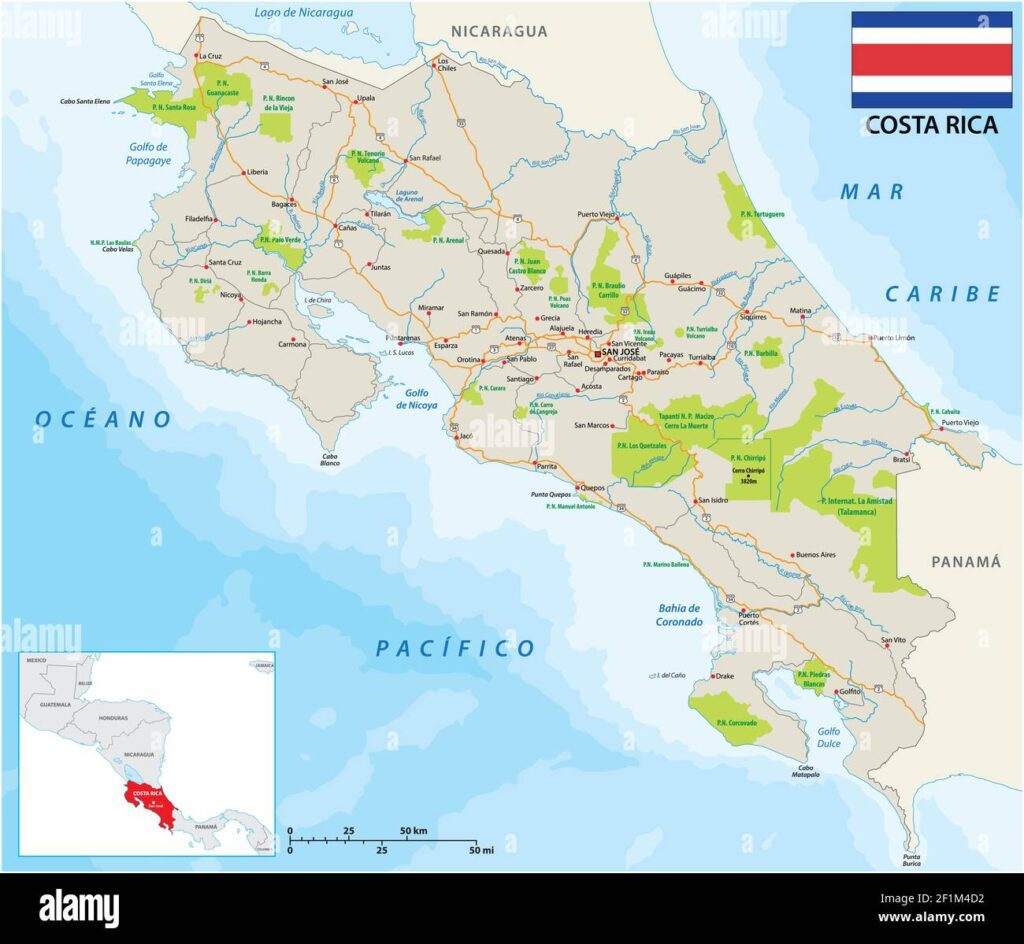
This tiny country, no bigger than West Virginia, sits in the transition zone between tropical dry forests to the northwest towards Nicaragua, humid mangroves along the northeast Caribbean coast, and tropical rainforests in the south toward Panama. Additionally, four different mountain ranges including a string of volcanoes crisscross the country creating hundreds of microclimates from sweltering humid forests and beaches, cool misty cloud forests, to freezing cold high-elevation grasslands reaching over 12,000 feet. Because of this, Costa Rica is home to approximately 5% of the world’s biodiversity. There’s no harsh winters here, so everything just keeps growing and producing all year long.
As a country, Costa Rica is considered the most peaceful country in Central America and the most democratic country in Latin America. In 1949, it abolished its army and has since invested in its people. Today the “Ticos” are generally well-educated and enjoy a higher standard of living than others in Central America.
They also consider themselves environmentally conscious. Costa Rica has preserved over 25% of its country in 30 different national parks and reserves, and regenerated forests to cover over 50% of its landmass. This has been an uphill effort as much of the country had been historically cleared for cattle grazing, pineapple and palm oil plantations. But with a strong commitment to the environment and a vision for promoting a new identity around eco-tourism, Costa Rica established aggressive reforestation programs that pay landowners to restore and protect their forests.
According to Google, “Ecotourism is a major driver of Costa Rica’s economy, generating significant income, creating jobs in local communities and diversifying the economy beyond agriculture.”
I definitely saw this in action. Everywhere I went, there were hundreds of tour guides, bus drivers, park rangers, and workers in hotels, restaurants and a multitude of other ecotourism businesses serving the tourists. Everyone I encountered in these positions were local Costa Ricans, native to that region and well-trained in their expertise. They also spoke great English. And, as I was reminded daily, the steep entrance fees into public and private parks, and the high price of tours, fund environmental protection programs and community projects, sustaining livelihoods in local communities. So, in Costa Rica, their green environment has become their economic gold and providing these rich ecotourist experiences has really become a national identity.
Adventure Tours, Costa Rican Style
Within my first few days in Costa Rica, I realized that without a car, I wasn’t going to see much of this country unless I doled out my hard-earned cash and took some tours. With that in mind, what did I choose first!? Rappelling off waterfalls and zip-lining, of course! Super fun to experience these adventures in La Fortuna and Monteverde.


Then, in my hostel, I met up with a few travelers from the US, Germany, and the Netherlands, and we spent the day hiking in the rainforest and swimming in El Tigre Waterfalls of Monteverde.


Later, I got myself to Cataratas La Leona in Curubandé. It was an amazing experience swimming through the blue pools and using ropes to pull myself against the swift cascades into the slot canyons of the Rio Blanco (White River).


After these few adrenaline-filled adventures, I was ready for some quiet walks among the trees. The misty cloud forests of Monteverde Cloud Forest Biological Reserve did not disappoint.
I loved learning about the swollen-bellied pit viper we saw wrapped in a tree, and the chain of caterpillars creeping head-to-toe across the forest floor in hopes of looking large and long to their predators. The strangler fig also fascinated. It doesn’t try to strangulate, it just grows toward the sun, engulfing a host tree in the process. Then, eventually, it absorbs all the nutrients in the soil so the host tree dies and rots away leaving the ficus tree as a hollow mass of tangled roots.


The night tour in the Monteverde Reserve also provided insight into sleeping birds, frogs and a surprise visit from an armadillo.


Manuel Antonio National Park
After spending a few days in the high-elevation cloud forests, it was time to head to Costa Rica’s mothership, Manuel Antonio National Park. This popular park was established in 1972, and is one of the smallest parks in the Costa Rican system- protecting only seven square miles of tropical forests and marine ecosystems. Despite its size, this is where tourists and locals flock to bathe on the beautiful beaches and wander the trails through the lush tropical forests.


Tropical rainforests are vital to protect in this world because they regulate climate, stabilize soils, provide clean water and shelter over 30 million species of plants and animals worldwide.
In Manuel Antonio, the wildlife are the stars of the show. Before arriving to Costa Rica, my research informed me that crowds were big in Manuel Antonio and the wildlife -especially the monkeys- were known to get aggressive stealing food and drinks from unaware tourists. Not anymore. In recent years, Costa Rica has decided to make this park their model for extensive wildlife conservation.
At the entrance, all of our bags were searched and any food, plastic water bottles, gum or candies with potentially smelly wrappers were confiscated. The new generations of animals are not to associate people with food, and wrappers and plastic garbage are no longer allowed into the ecosystem. At first I was really taken aback- after all, confiscating my things seemed a little extreme. But then another traveler turned to me and said, “It seems like they care more about the wildlife than the tourists.”
Wow. Yeah. Maybe that’s how all National Parks should be.
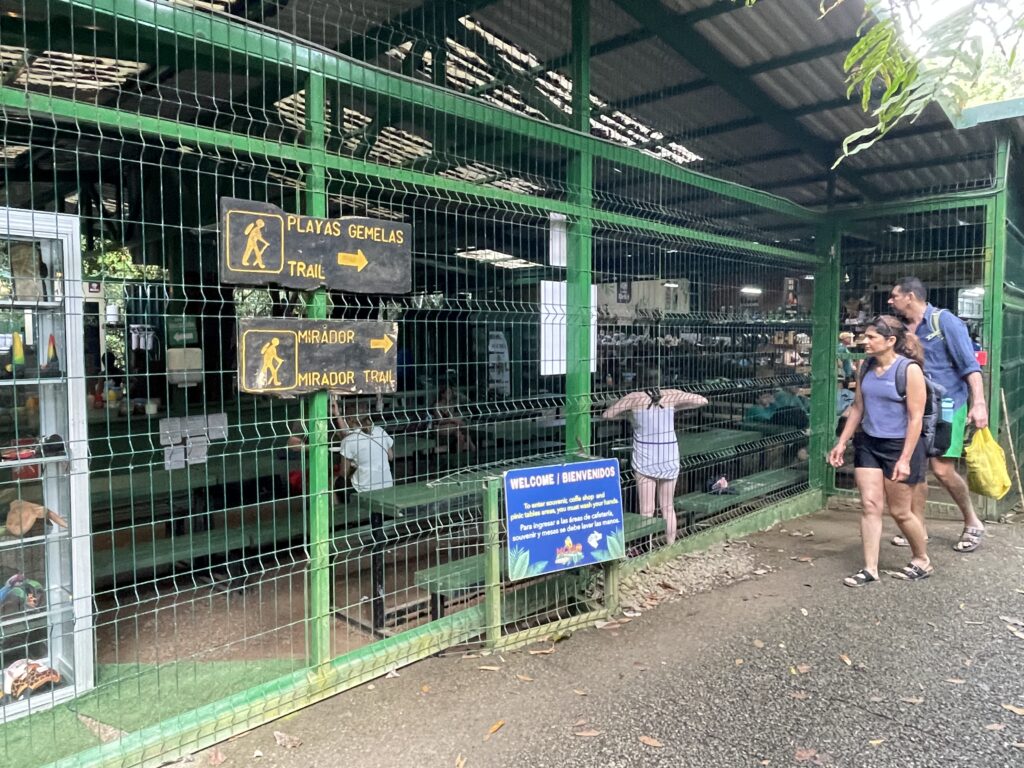
Inside Manuel Antonio National Park, visitors can purchase food and a drink, but it must be entirely consumed inside the fenced-in cafeteria. In this park, it’s the humans that are in the cages!
So, with a much lighter backpack, and the powerful telescope of my tour guide, I spent the morning enjoying some of the wonders of the park. Can you find… the iguanas, a lizard, a snake, a translucent white frog, a coati, a spider web, a land crab, and two bats?


Manuel Antonio National Park is also home to Two and Three-Toed Sloths, and three different kinds of monkeys: White-Faced Capuchin, Mantled Howler, and Squirrel.


I saw all of these animals, but it was the White-Faced Capuchin Monkeys that were the easiest to photograph and the most fun to watch.
Participating in adventure tourism and seeing the animals in the tropical and cloud forests were definitely highlights of my travels in Costa Rica. But there was so much more I experienced. Stay tuned for my next blog posts about life and wildlife in Costa Rica!


Thanks to Kinzee -a friend from Peace Corps- whose warm hospitality and great conversation helped bookend my stay in Costa Rica. I really appreciated my rest days in your home!

Linda Long
Pura vida, Becky! Costa Rica is a treasure, indeed. I stayed there during the summer of 1992 as an exchange student in highschool. It was a magical experience and holds a special place in my heart. I loved seeing your photos and learning about the wildlife refuge. What a great education model to learn about animals in such a respectful way. You look so happy and vibrant! I love reading about all your adventures.