During my multi-month travels, I get a little tired of moving all the time. I’ve learned the true value in slowing down, even stopping and staying awhile, getting to know the locals and their community. One excuse for doing this is to find a place to volunteer. If you’ve been a long-time reader of this blog, you’ll know that I’ve volunteered on a coffee finca in Colombia, a bakery and gardens in Argentina, and a bed and breakfast in Chile. This year, I searched for a way to volunteer in Bolivia; I found the perfect place in Cochabamba.
Cochabamba is a large city sitting at about 8,000 feet in the mountains of Bolivia. The climate is eternally perfect, the locals are friendly and there’s lots of parks and restaurants to entertain everyone.


In Cochabamba, I found Adelante Mujer, a non-profit organization helping women build lives free from violence. Within this organization, the women learn, grow and share in a community of support. Adelante Mujer, which literally means “Forward Woman”, accomplishes all of this in many ways.
Adelante Mujer
First, Adelante Mujer has a community center which is where all the women meet weekly. At these meetings, the women learn new skills from outside lecturers and from each other, participate in team-building activities, plan outreach events and decide how best to carry on together.


This beautiful community center and outdoor learning space is at the heart of Adelante Mujer. This is also where volunteers, like myself, are able to live.
At that community center, the women also come together to hold cooking workshops for tourists, or cook foods to sell at the market, earning money for their programs. Over the years, these women have gained valuable skills in business, marketing, and financial management, not to mention a lot of self-awareness and self-confidence. Through their efforts, the women have become close friends providing a network of support, despite sometimes having difficult lives at home.
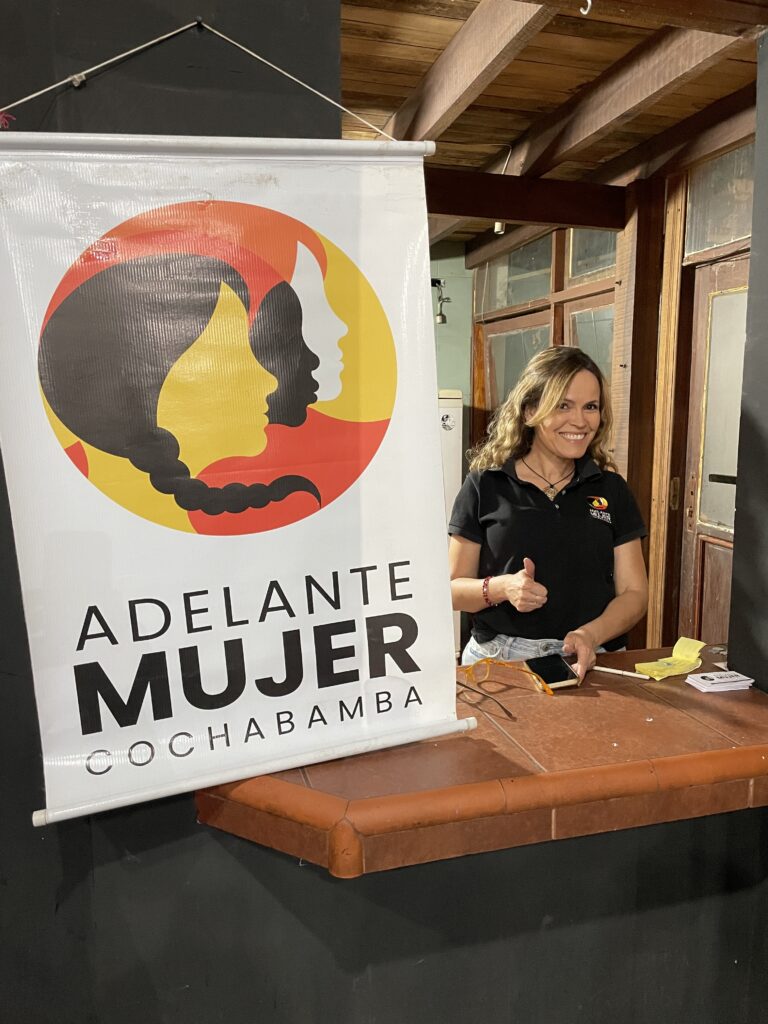
Fabiola works tirelessly as the Coordinator of Programs at Adelante Mujer.
Machismo Culture in Bolivia
As soon as I crossed the border into Bolivia, I recognized a machismo – or hyper masculine – culture. Call it women’s intuition, but I immediately felt a strong sense of masculinity and aggressiveness in rural Bolivia that I hadn’t witnessed in other countries during this trip. Here, women are more passive and adhere to traditional gender roles. With concerns for my own safety, this male-centered attitude gave me more pause than usual, so I started doing some research.
Google says, “Bolivia has one of the highest rates of violence against women in Latin America, with approximately 70% of women experiencing some form of abuse. Data indicates that 64% of women have been victims of emotional, physical, or sexual violence from their partners. These issues are widespread, deeply ingrained, and often underreported.”
It should be noted that Bolivia is making strides in gender equality, particularly in political representation and support for Indigenous communities, but intimate partner violence is still high and “there is a large gender gap in unpaid labor, where women work four times more hours than men.”
One of the things Bolivia is doing to combat this inequality is to provide better opportunities for education. In recent years, Bolivia has dramatically increased their adult and child literacy rates to over 95% across the country. How did they do this? They started with massive government spending (~23% of the annual budget) to hire more teachers and expand school infrastructure across all rural areas. Then they created short, intensive programs for all ages and honored intercultural bilingual education to teach people in their local indigenous languages. I saw many examples of these efforts as I traveled across the country.
So, while things are slowly getting better for women in Bolivia, organizations like Adelante Mujer, and the volunteers that support the program, are making immediate differences everyday. In the three weeks I was there, I participated in the International Women’s Day March, I helped prepare food and sold it at cultural events to raise funds for the organization, and during their community meetings, I cooked treats for the women, entertained their children, and gave the whole community center a good cleaning.


Volunteers like myself come to work at Adelante Mujer while on their travels. The volunteers I worked with were from Spain, Italy, Poland, and France.
Can I Take Your Picture?
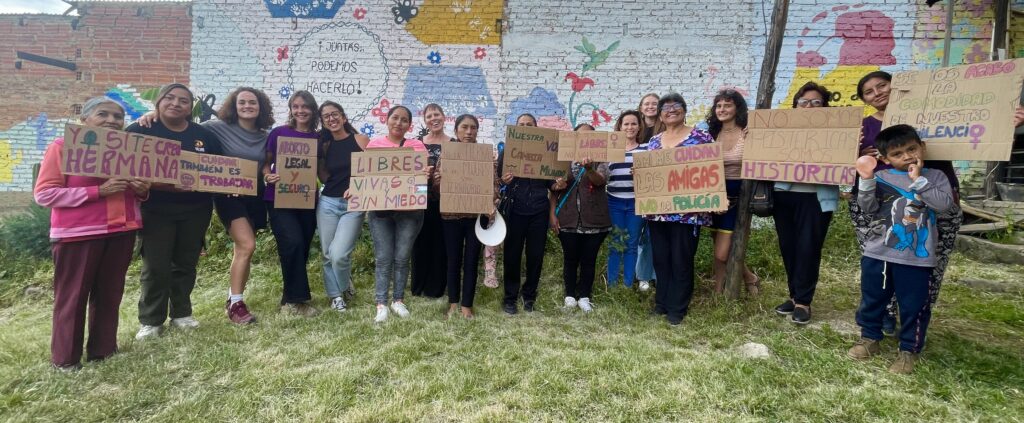
Of course, while I was there, I also took a thousand pictures of these beautiful women laughing, loving and learning together. The more that I clicked away, however, the more I realized that many of them were uncomfortable with concern for what I was going to do with my photos. I learned that many Bolivians believe that there’s a spiritual power in a photograph and they don’t often consent to being in front of the camera. Others were concerned they would be identified publicly, which could compromise their personal safety.
On my last day there, as we were preparing posters for the Women’s March, I told them that I write a blog and that I wanted at least one photograph of the Mujeres to put on the internet. Some refused to participate, while others allowed that if they didn’t want their faces shown, they could use the signs as a cover. Most of the faces that you do see here are the volunteers. But none of the matters. What matters is that all of us women from so many countries are there together, standing up for each other and the women of Bolivia, the best that we can.
After leaving Cochabamba and Adelante Mujer, I continued on my journey across Bolivia to La Paz, the Administrative Capital of the country. There, I stayed three days, wandered the vibrant city and took a few tours as well.
La Paz, Take Two
Ironically, I came to La Paz specifically to further my own story as a woman. Twenty years ago, I visited La Paz with my then husband. We were on our honeymoon. We loved La Paz, but over the course of two weeks, we got robbed, had a few fights about that, and he lost his wedding ring. (There sure were a lot of red flags from the start!)
I don’t remember many details from that trip, but I do remember loving this colorful and energetic city. I loved the way its buildings drop dramatically from the cliffside into a jumble of narrow, serpentine and cobblestone streets. I remember the vendors loudly hawking their wares to the chaos of constant car horns. And of course, I took lots of photos of dead llama fetuses hanging from the doorways while oodles of travel agencies lined the streets promising high altitude adventures. In my memory, it was all very crazy!


Some people may not want to relive places that bring up difficult memories from the past. But, I decided that I wanted to return as a single woman to make new memories of this place on my own. So, this year, I went to La Paz again and I’m happy to report that it hasn’t changed a bit. I loved it just as I did before. Probably even more.
And so, as a empowered women, and to continue my support of women in this country who are empowering themselves and bucking traditional trends, I especially wanted to support the Cholitas!
Cholitas, Bolivian Indigenous Women Pushing the Boundaries of their Culture
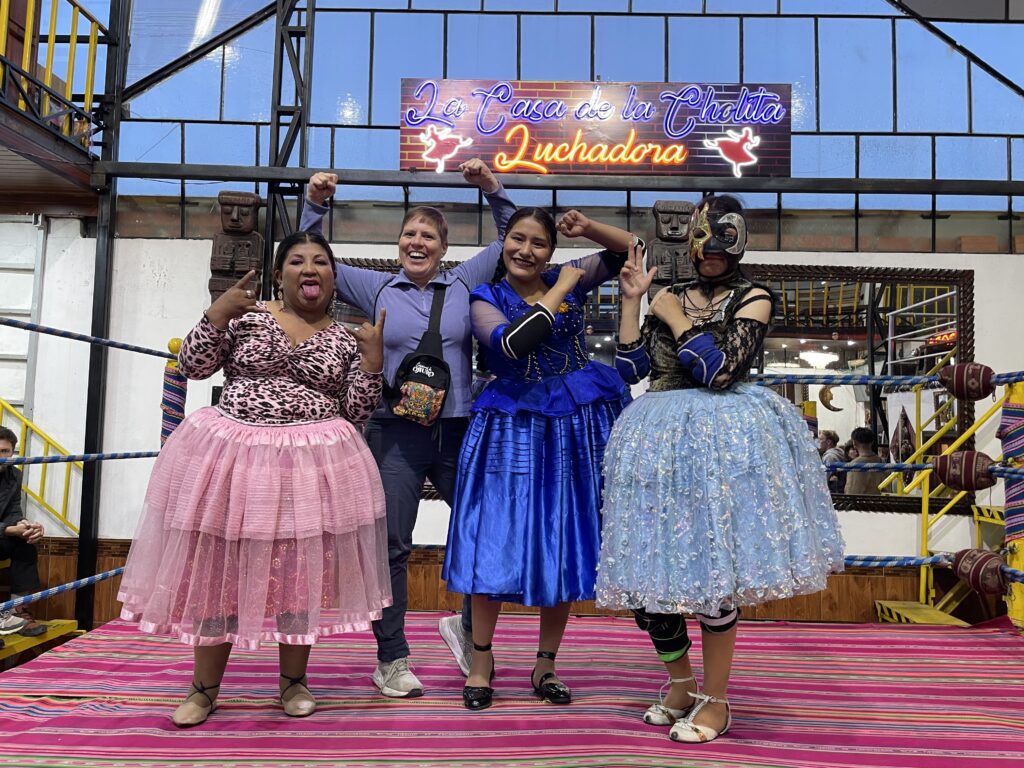
Cholitas are traditional Indigenous women from Aymara and Quechua communities who live across Bolivia and Peru. They are easily identified by their colorful wide skirts, traditional bowler hats and two long braids cascading down their back. For centuries, these people (especially the women) have been marginalized, suffering intense racism and discrimination. But now, after years of fighting for their rights, they are seen as empowered symbols of cultural pride. Cholitas, in their full skirts, are breaking down gender barriers and proving themselves as entrepreneurs, mountaineers and wrestlers.
So, how does a tourist like myself support the Cholitas’ efforts of self-empowerment? You buy a ticket and go see their show! Welcome to Cholita’s fight-night, the Luchadoras (the fighters)!


La Luchadoras (the Fighters)
Before the show, we were treated to a presentation that helped us understand the cultural reasons for all of their clothing layers and their desire to prove themselves in non-traditional ways. Besides being workers, students, mothers and daughters, getting support from their family and taking time to train has obviously been a struggle. But it’s the sport and empowerment that they love, so these women train hard to reduce injuries and make their stunts look easy. Here’s a video to help you understand a bit more about their show.
At the end of the show, the Cholitas invited us up on the stage for a photo. We also got to gawk at their “Wall of Fame” and their training rooms.


I love that during my solo travels through Bolivia, empowered women became part of my story, too.
After all, we’re all Luchadoras!