
In my last post, I shared with you the incredible remote landscapes of Southwest Bolivia which I experienced during a 4-day tour. You may remember, I was with two other couples from France and Germany, and our Tour Guide, Raúl. If you didn’t get a chance to read it, that article is here.
Today’s post will cover the final two days of our tour where we really got personal with the enormous salt flat, Salar de Uyuni.
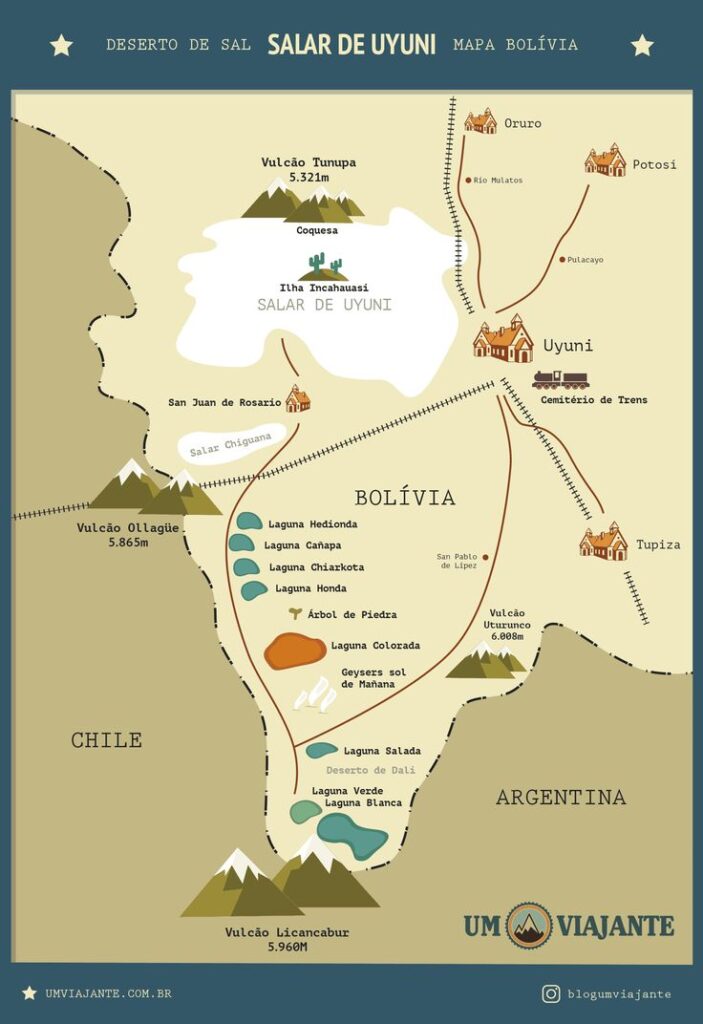
Days 1 and 2 of our tour took us from Tupiza to the far southwest corner of Bolivia near the borders with Argentina and Chile. It is there we saw all the colorful lagoons and the flamingos. For days 3 and 4 of our tour, we headed north to learn more about the Salar itself.
“Salar” means salt flat and the salt flat in Southwest Bolivia is the largest in the world measuring over 4,000 square miles. This is about 25 times larger than the Bonneville Salt Flats in Utah. The Aymara people originally called it the “Salar de Tunupa” after a sacred volcano nearby, but eventually the name was changed by visitors to include the landmark city of Uyuni.
The Salar de Uyuni is over 30,000 years old and was formed by the drying of several large prehistoric lakes which covered most of Bolivia, and some of Peru, Argentina and Chile! The evaporation of these lakes left behind this concentration of salt, minerals and mud that now extend up to 400 feet deep.
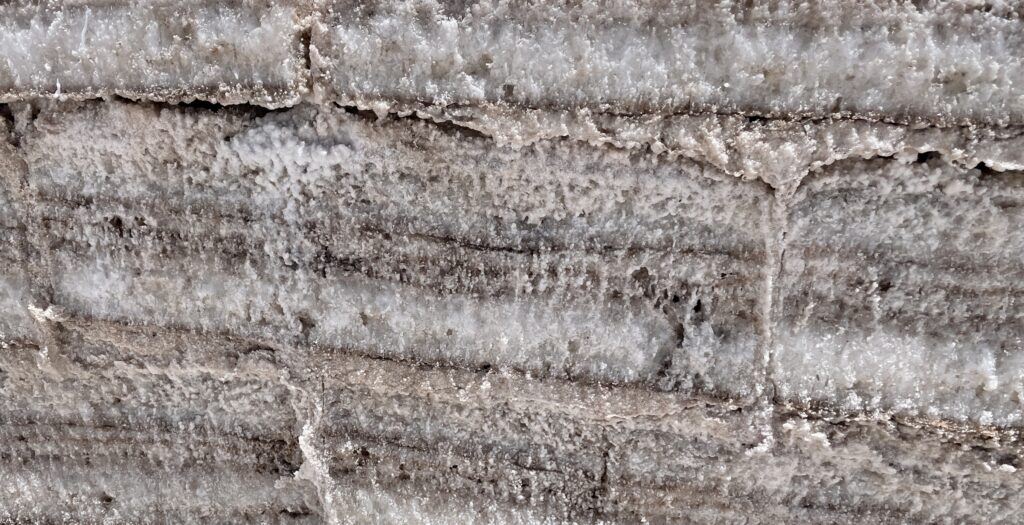
The surface of the Salar sits at about 12,000 feet above sea level and is predominantly made up of sodium choloride (salt) with a brine underneath that contains boron, magnesium, potassium and massive reserves of lithium. During the rainy season, rain water and water flowing in from nearby rivers forms a shallow layer of water on the top of the Salar. It eventually seeps into the crust which dissolves the salt. Then as the water evaporates, the salt settles into a crystallized crust again. This cycle repeats itself annually making distinct lines or layers in the cross-section of the salt.
How the Salt is Used
The salt of the Salar de Uyuni is harvested locally by small companies based in Colchani at the edge of the flat. About 25,000 tons annually are dried, processed, iodized, packaged and distributed around Bolivia and the world. On the last day of our tour, we got to visit one of these salt plants. Raúl demonstrated the process for us.


Salt is also used for construction. Rectangle blocks are cut from the dry salt and used as bricks to build houses and hotels. It’s easy to see the lines or layers of the annual wet and dry cycles of the Salar.


This Salt Hotel was really fun to stay in. All the walls, furniture and the floor covering were made of salt. (Yes, I licked them!) On the outside, the whole building was wrapped in plastic to preserve the salt blocks from dissolving in the rainy season.
The Salar’s Lithium Reserve
Geologists have recently discovered that underneath the Salar is a huge lithium reserve. It is estimated that over 60% of the world’s known lithium is under the Salar de Uyuni. Since lithium is the key component in batteries, I think mining the Salar will be front and center in the future. Supposedly, Bolivia has established some strict environmental regulations, but Chinese and Russian companies are already working in the area. We didn’t get close enough to the lithium plants to take pictures, but we did see a train maybe filled with lithium heading to a Chilean port for exportation.


Sunrise and Sunset on the Salar
One of the draws to the Salar de Uyuni is its photographic nature. The landscape becomes especially dynamic during sunset and then again at sunrise. We were lucky enough to get to see both! For our sunset adventure, Raúl surprised us with a bottle of wine and it was a thrill to enjoy it in the drama of a storm rolling across the landscape.


At sunrise, we drove out onto a dyke. Since it’s the rainy season, the low parts of the Salar get flooded with water and it’s fun to take pictures of the reflections.


After sunrise, we slowly drove out into the water but Raúl explained to us that if the water got too deep, we were in danger of getting stuck or having the salt water lock up the components underneath the car. There’s countless stories of tour groups getting stuck out in the Salar de Uyuni and not being found for a few days. It’s that big!


Because the salt isn’t completely solid throughout the Salar, we came across some sink holes that were quite deep. Yikes!
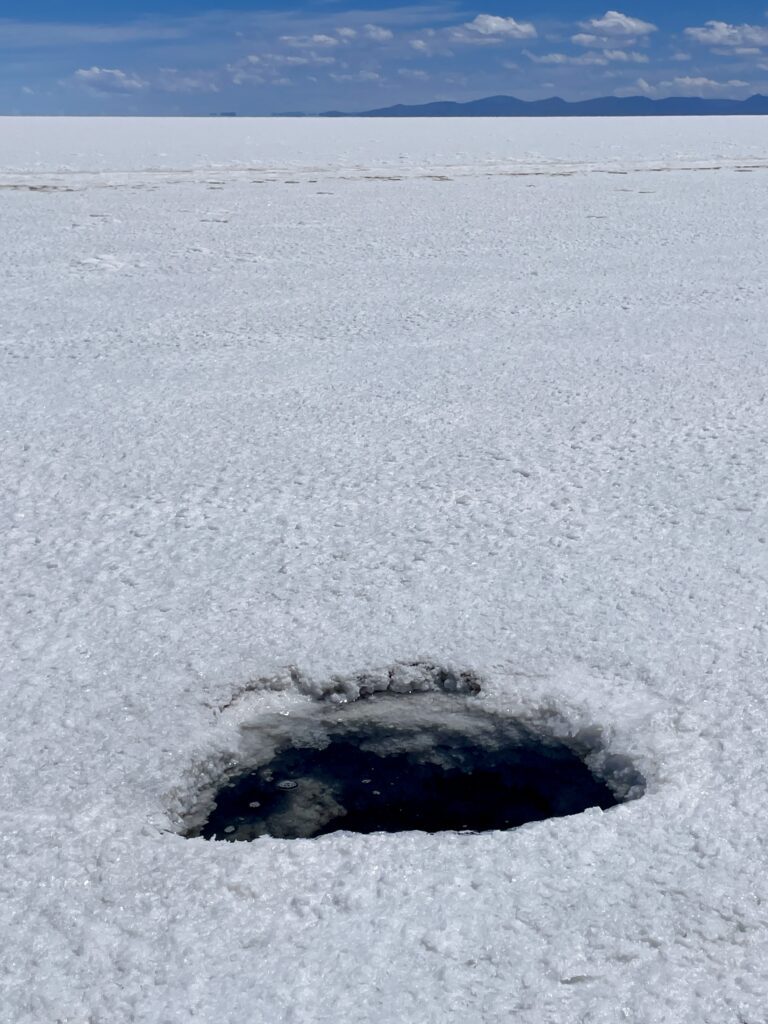
But mostly, as we drove across the salt flat for over three hours, it was a white, featureless desert of salt.


Near Colchani, and the edge of the Salar, we came upon this international monument where people from all over the world had placed their flag. Surprise, surprise, the US flag wasn’t even there.


Silly Perspective Pictures on the Salar
Because the Salar de Uyuni is so big, and the flat, white featureless landscape removes normal perspective and depth perception, it’s easy to take images that distort size and distance.
Raúl, our guide, was great at facilitating just the right pose!


There’s a book by Karen Hesse called “Out of the Dust” about the Dust Bowl of the 1930’s. She spends a lot of descriptive time describing all the dust and by the end of the book you feel like you can taste it when the wind blows. Our 4-day tour of the Salar was something like that. Packed with so many different landscapes and so much learning, I walked away feeling like the salt and dry earth was in my pours. It was the perfect way to fully experience the Salar de Uyuni, and the best of Bolivia. It’s a very special place indeed!
My tour group made this hilarious video out on the salar. Because it is downloaded from someone else’s phone, I cannot directly import it into my blog so this link takes you to a YouTube site. It’s worth your minute to smile! I’m the first and last dancer out of the can. Enjoy!

Dawn Fulps
All I can say, we love you sharing your adventure!