
I made it to Rio!
Rio de Janeiro! I mean, who wouldn’t be excited to come here?
Well, me.
Let’s get real for a moment. I was a bit scared to come to Brazil. I know I present myself as being fearless and enthusiastic for every adventure, but I really shuffled my feet planning this trip.
Why?
Because Brazil is so big. The distances between sites are overwhelming. It’s really, really hot. And the language! I don’t know how to speak Portuguese!
Spanish was so hard for me to learn and now, after all that effort, traveling in Spanish speaking countries is completely within my comfort zone. So, the idea of traveling to a country where I couldn’t communicate again seemed like a frustrating proposition.
But, I reasoned with myself, if I’m going to continue to grow and learn and travel to other places around the world, I need to not let a lack of language deter me. So, in reality, I came to Brazil to push myself.
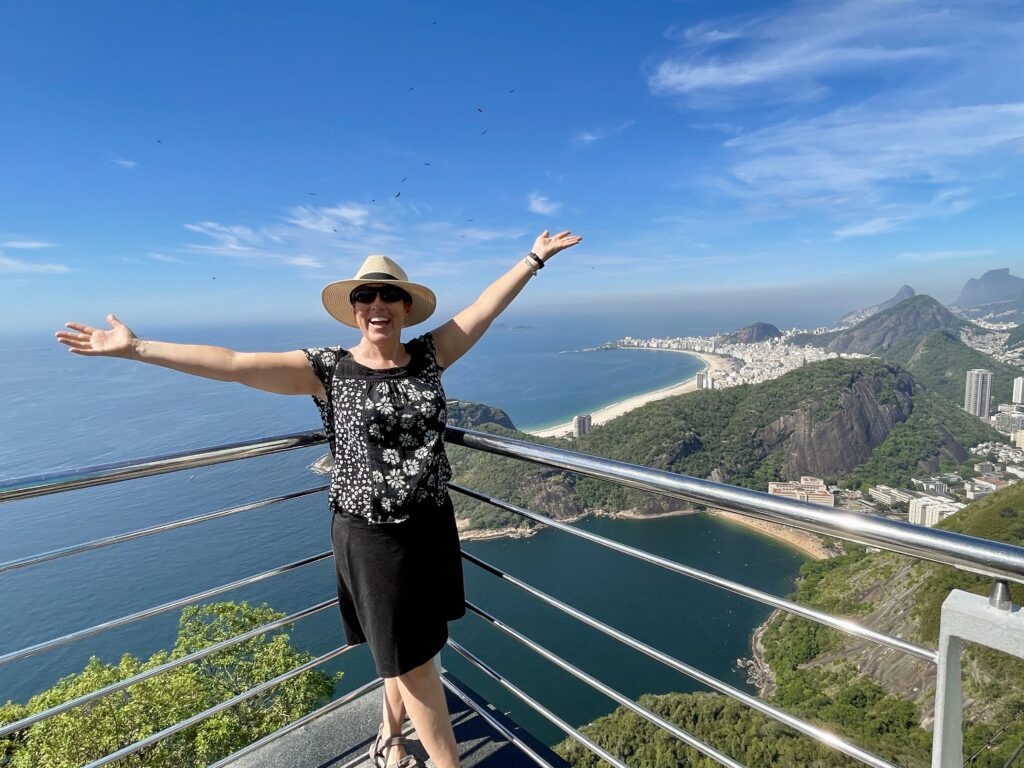
Three short weeks was what I decided I could do. It would be a reconnaissance mission, to get to know parts of just the southeast coast. A dip of my toe into the culture and the language. Rio de Janeiro would be my first stop.
Usually, as I travel, I don’t spend too much time or money on tours, preferring to figure out how to explore on my own. But the idea of navigating on my own was daunting in a huge city, much less in Portuguese, so I acquiesced. For four days, I frequently used Uber and signed up for three different English/ Spanish tours.
Highlights of Rio de Janeiro
First, an all-day Rio Tour showed me the highlights of this beautiful city! We took the tram up Sugarloaf Mountain- Pão de Açúcar– to gasp at the deep blue of the Atlantic Ocean, as well as the myriad of different neighborhoods tucked among the folds of the mountains in the expansive city below. Rio, with a population of over 14 million, is considered the third largest city in South America, after São Paolo, Brazil and Buenos Aires, Argentina.
On this same day-tour, we took a bus up to the Christ the Redeemer statue overlooking a different part of the city and the green reforested hillsides. The Christ, or Cristo Redentor, stands at over 98 feet high and was built between 1922-1931 by Polish, French and Brazilian artists / engineers. It is made of reinforced concrete and soapstone, and is considered one of the Seven Wonders of the World. Yup, it’s big. But I was honestly surprised at how small it looked from the city down below.


The highlights of Rio continued on other tours as I visited the outside of soccer stadiums and learned about the famed World Cup teams. Of course, all things soccer is on a “Highlights Tour of Brazil”! We also learned about the changes made to the city for the 2016 Summer Olympics.


One famous transformation for the Olympics was the production of the largest mural in the world. It is called Mural das Etnias (Ethnicities Mural) and it was created by a Brazilian street artist named Eduardo Kobra, who has gone on to make an even larger mural in nearby São Paolo. Across 3,000 square meters, he painted five different faces representing humanity’s common ancestors, the ethnic tribal people from five regions of the world. Here are three of the images representing a Huli man from Papua New Guinea, a Mursi woman from Ethiopia and a Tajapo boy from Brazil. Although the colors have faded since its debut, the mural is still very impressive to see.


When I’m traveling, I do try to learn about the stories that aren’t told in mainstream tours. So, other than the popular “Tour of Rio”, I spent my time and money on tours to learn about the heritage of the African Brazilians, and those who still live in marginalized communities like the infamous favelas of Rio.
Pequena África (Little Africa)…Embracing Dark Histories in Brazil
Have you ever taken a “Free Walking Tour”? These tip-based tours can be found all over the world and are led by locals who share their stories. In Rio, I signed up for a tour of the neighborhood called Pequena África, or Little Africa. As their website states, “When visiting Brazil, it’s impossible not to talk about the influence of Africa on our culture!”. The music of samba, the art and sport of capoeira, and the traditional flavors such as feijoada all have their roots in the African enslaved communities of Brazil.
Between the 1600’s-1800’s, over 2 million enslaved Africans were brought through Rio de Janeiro, making it the largest slave-receiving port in the world. During the height of the trade, the largest percentage of these people passed through Valongo Wharf, near downtown Rio, on their way to expansive coffee, tobacco and sugar plantations. After 1831, when the slave trade was made illegal, and eventually abolished fifty years later, freed Africans gathered near this port to find work and a sense of community. Most of these people were from the Congo and Angola, starting free lives, and melding traditions old and new.
In the years after abolition, the city no longer needed the slave market at Valongo Wharf, so the space was buried and renovated for different uses. But in 2011, during preparations for the 2016 Olympics, the ruins of the wharf were unexpectedly unearthed. Further excavations revealed thousands of buried personal objects and mass grave sites. Because these objects are considered the most signifiant physical evidence of slaves and the slave trade in history, the city of Rio decided to honor this place as an outdoor museum, and UNESCO named it a World Heritage Site in 2017.
On the same day where the headlines of the New York Times announced the dismantling of signs and stories at national museums in the United States- all in an attempt to white wash the history of enslavement on our own shores- I was on this tour learning how Brazil has built museums, memorials and cultural centers to honor their African diaspora.


To honor the resilience and memory of the African people, a baobab tree, a native African tree known as the “Tree of Life”, has been planted at the Valongo Wharf.
On our Little Africa Tour, we also learned about the culture and resilience of this community. Much of the neighborhood’s history is depicted in murals honoring their important leaders and the birthplace of the style of music called samba. For decades, laws similar to Jim Crow did not allow dancing or the playing of this type of music in the streets. After decades of fighting, samba was finally legalized in 1930 and today is part of Brazil’s national heritage.


I really didn’t know anything about samba before I came to Brazil. It was described to me by another traveler as a cross between slow jazz and elevator music. In my opinion, that’s not too far off. But clearly, these are the sing-a-long songs that make Brazilians swoon. So, that very night, I decided to hang around the Little African neighborhood with another traveler from Switzerland to catch a little of the weekly samba music street festival at Pedra do Sal. Always held on Monday nights, the traditional day-off for the slaves and workers, it was a great way to experience a little of the sounds and flavors of Brazil.


Rocinha, a Glimpse into a Favela
With the same idea of learning about other populations and experiences different than my own, I signed up for a tour of a favela – a slum of Rio. There’s all kinds of reasons not to do this, but honestly, sometimes these types of tours give voice to the people who live within. Unfortunately, this tour wasn’t really the case. The tour was very controlled. We saw the main street, and small sections of the winding labyrinth of alleyways and met a couple of local people who cash in on tourism. Photography was generally not allowed and questions were a little discouraged. Basically, we saw a functioning city within a city, but those who control it, and the means of how they control it, were not discussed.


For me, the most interesting part of the favela tour was the demonstration of “capoeira”. This is an Afro-Brazilian martial art that combines elements of dance, acrobatics, music, and spirituality. I’ve actually seen this performed before in other places in South America, but I didn’t know what it was. Here in Brazil, on the tour of Pequena África and the Rocinha Favela, I learned more about this art form.
Santa Teresa
As I started to become more comfortable in Rio, I learned how to take the Metro subway and get myself to some more distant neighborhoods. High on the hill sits a bohemian neighborhood named Santa Teresa. One afternoon I wandered the streets, enjoyed the artistry and a little bit of local flavor, too. The fresh fish in Brazil is amazing!


Escadaría Selarón (Selarón Steps)
In 1990, a Chilean artist named Jorge Selarón started transforming a crumbling staircase near Santa Teresa with blue, green and yellow tiles to honor the colors of Brazil. But soon, upon hearing of his efforts, friends and visitors from around the world started donating tiles which turned it into a global art project. The Selarón Steps have been a popular attraction in Rio for a long time, and Selarón continued adding and replacing broken tiles to the staircase until his death in 2013.
It was really fun to wander the steps looking at the variety of tiles. I found many representing different US States- including a few from Alaska! I also saw many from other countries, as well as depictions from various time periods around the world. A very beautiful mosaic, indeed! And, yes, I climbed all 215 steps with ease!


But what about the famous Rio beaches? Yes, this mountain girl spent time at the beaches, too.
Praia de Copacabana (Copacabana Beach)
During my time in Rio, I stayed at a hostel near the famous Copacabana Beach. And since you’re wondering, the answer is “No”, Barry Manilow’s famous song “Copacabana” is not about this Brazilian beach. Nonetheless, it’s a very long, beautiful and famous beach, as you can tell by the crowds on this lovely Sunday afternoon. I walked the entire beach and realized I was the only woman in the entire city with a one-piece swimming suit! There’s not a lot of coverage in Brazil for any body!


As I walked, I noticed a little statue way up on the hill in the distance. Do you see it? The Christ the Reedemer statue seems small from so far away. Rio is a huge city!
Açaí; a Healthy Brazilian Treat
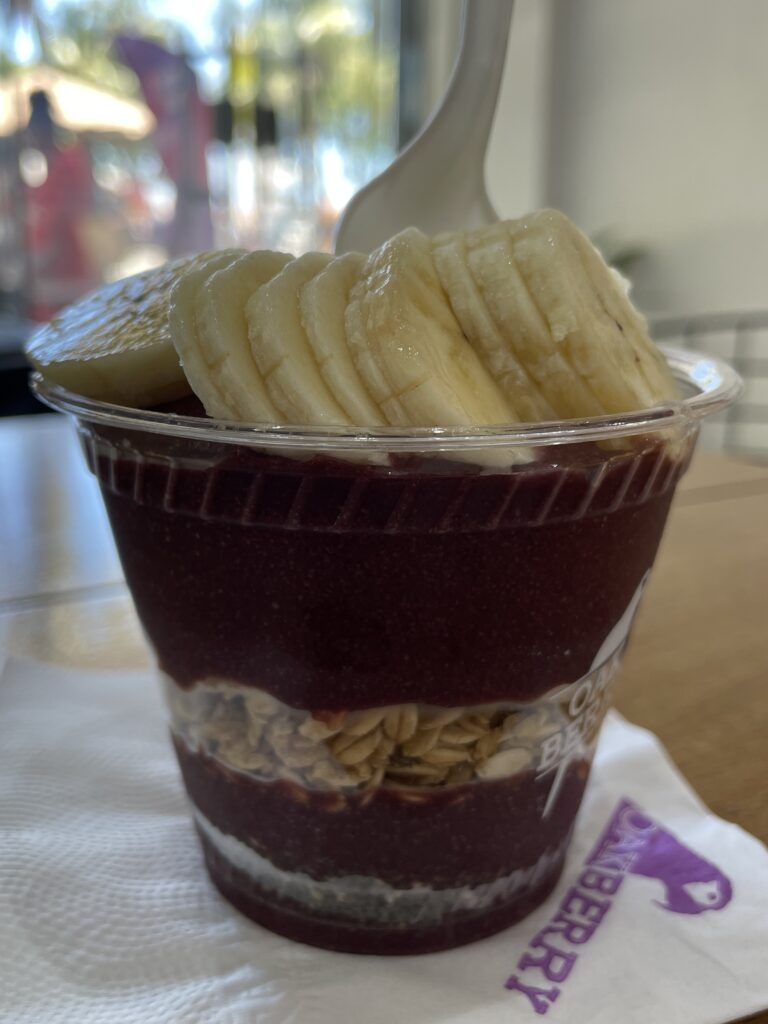
After all the heat and crowds, I headed off the beach to indulge in a traditional Brazilian treat; Açaí! Pronounced “ah-sigh-EE”, it is a dark, purple berry from a palm tree native to the Amazon Rainforest. It is considered a superfood, rich in antioxidants, fiber, and healthy fats. Here in Brazil, it is served everywhere as a frozen puree. I’ve decided that I really like it with bananas, granola and nuts, although others mix in chocolate, nutella and other types of fruit. Whatever your fancy, it’s cold and delicious and I’ve eaten a cup every day since!
Praia de Ipanema (Ipanema Beach)
Rio is beautiful at all times of the day, but at sunrise and sunset, people of the city gather at different viewpoints to mark the occasion. One of these places is Ipanema Beach (yes, “The Girl from Ipanema” really is a song about a girl from Ipanema, Brazil.)
On the first afternoon of my visit, I left my hostel and was wandering toward the beach when I realized that large crowds of people were all heading the same way. So, I started following them and we ended up at Arpoador Rock, an outcropping of rock giving the best view of the sunset over Ipanema Beach. The crowd was immense and as soon as the sun set, a big cheer erupted. I really liked this idea – cheering to celebrate the end of the day. So, I went back on another night to watch it all again.


All in all, my four days in Rio were a success. Did I have to pay the “Gringo Tax” a few times because I didn’t understand my options or couldn’t negotiate in their language? In other words, did I get ripped off a little? Yup. But really, not enough to worry about. And was the lack of language a big problem. Sometimes. I didn’t get to ask all my questions or have interesting discussions with the locals like I prefer. That was hard.
But Rio is a stunning and vibrant city with so many things to do. I really enjoyed all it had to offer and I barely scratched the surface. I’d definitely come back, maybe in the cooler months of the year.
Who wants to join me?

hamburger helper
You continue to uplift me, Becky! Thanks.