
I love sea turtles. In my past adventures, I’ve had a couple close encounters swimming alongside them in Hawaii, Mexico and the Galapagos Islands. They seem so old and wise, effortlessly propelling themselves through the green abyss of the sea. These have been moments in time that have touched me deeply.
Thinking of these experiences is a large part of the reason I headed to Costa Rica this year. I really wanted to see sea turtles! After some research, I learned that during the month of November when I would be visiting, my only chance of seeing a sea turtle in Costa Rica was along the Pacific Coast at Playa Ostional (Ostional Beach). This is where the Olive Ridley turtles really put on a show!
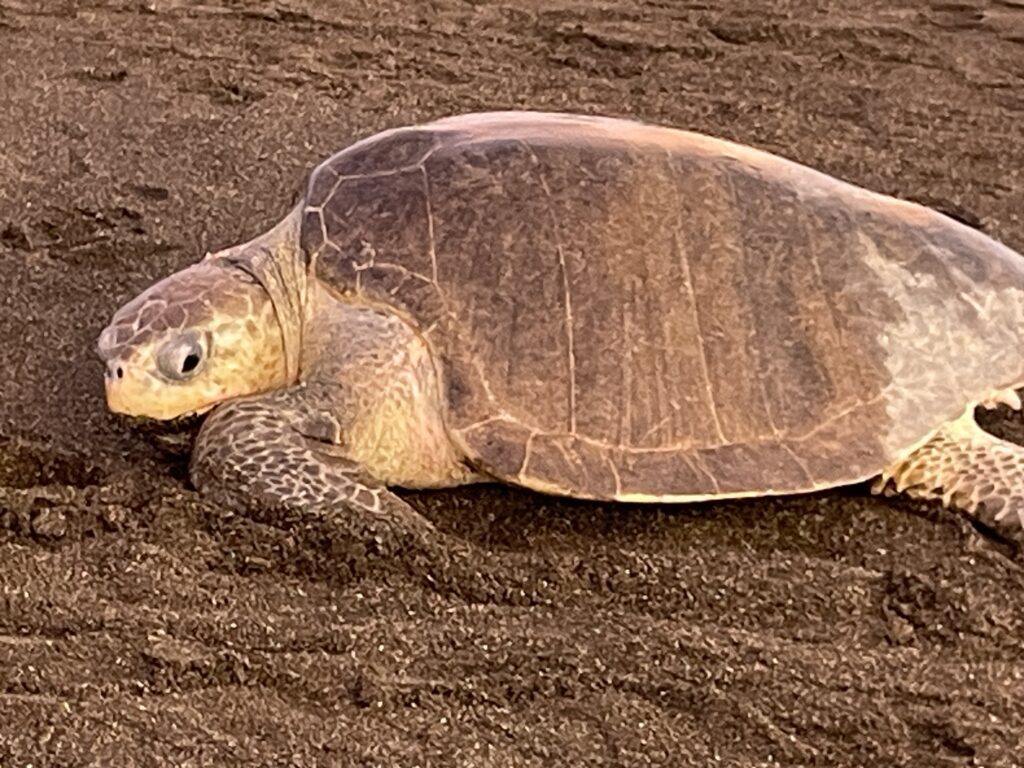
There are seven types of sea turtles found in all oceans of the world. Olive Ridley turtles are the second smallest, measuring about 2 – 2 1/2 feet long and weighing between 75-100 pounds. Like all sea turtles they breathe with lungs, constantly surfacing for gulps of air. To drink, they extract freshwater from saltwater and excrete the excess salt through ducts near their eyes. Olive Ridley turtles from Costa Rica migrate long distances throughout the eastern Pacific Ocean, feeding on invertebrates like crustaceans and mollusks. Female Olive Ridley turtles reach sexual maturation after 15 years and miraculously return to the same beaches where they were born to lay their eggs in the sand.
When it is time for a female turtle to lay their eggs, Olive Ridley turtles do something phenomenal. In only a few beaches around the world, thousands of these turtles gather together out in the surf and come ashore en mass over three to five nights to lay their eggs. This is called an “arribada“, or arrival. During this time, the beach is covered with thousands of Olive Ridley turtles each laying about a hundred eggs. Costa Rica has two beaches that host these miraculous arribadas. One of the beaches is Playa Ostional.
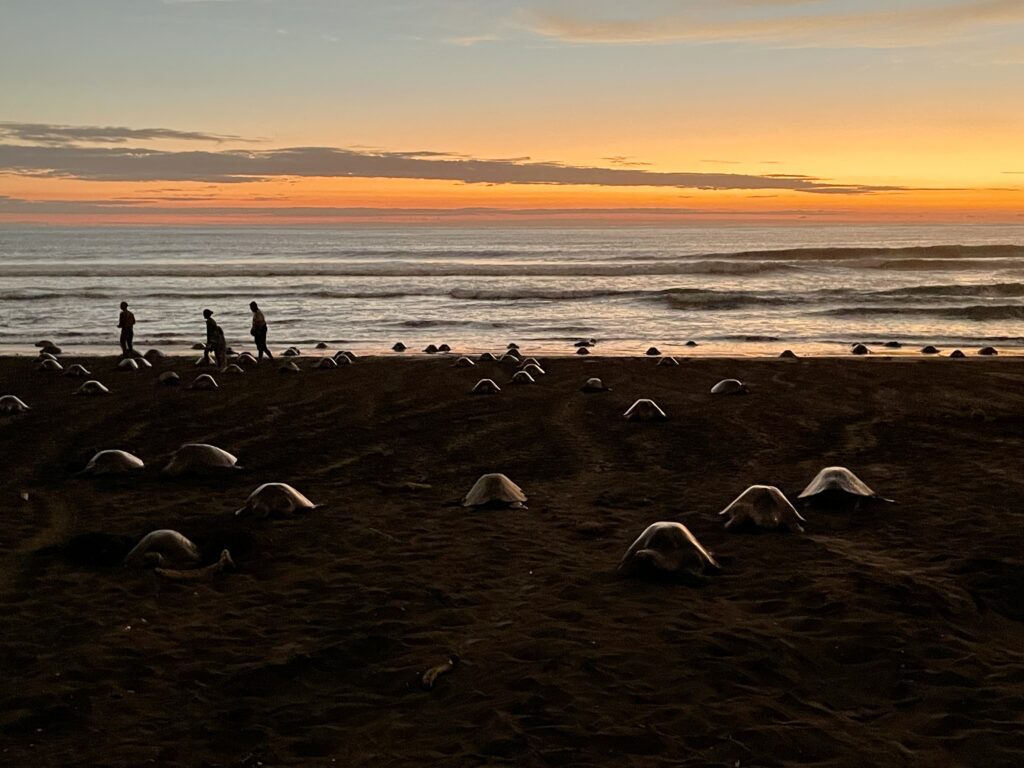
November Arribada at Playa Ostional
From a guidebook, I learned how to contact the Association of Tour Guides who patrol the beach and post the numbers of turtles arriving daily on their Facebook Page. I was several hours away in a different region of Costa Rica when I realized that the arribada for November was in its second day and if I didn’t move fast, I’d miss it all together.
So, what’s a turtle-loving traveler to do? I hopped a bus that morning, finding another bus to the next town and the next town, finally reaching Ostional late that afternoon in time to purchase the last ticket available on the 5pm tour; a chance to watch the turtles coming up the beach at sunset.
Although the reason for mass nesting is unclear, scientists believe it’s a form of defense against predators. By laying hundreds of thousands of eggs, turtles overwhelm egg-loving predators like vultures, and mammals like coati. Some believe that the exact timing of the arribada depends on the moon and the tides. The turtles seem to gather off the coast during the last days of the waning moon and come ashore in the darkest nights around the new moon. Therefore, this phenomenon only occurs once a month for only a few months a year.
My tourguide told me that her father insists that the turtles started to arrive in the 1950’s. By the 1970’s, the numbers were significant enough that biologists started to pay attention and one started a university center nearby to study the events. In 1983, Costa Rica established the Ostional Wildlife Refuge, which protects 13 miles of beaches and ocean around the area. There are also specific rules closing the Ostional Beaches to anyone not officially working or taking a tour during the time of the arribada.


I was so enamored by the strength and patience of these mama turtles, I ended up taking two tours, one at sunset and another the next morning at first light. It was a very emotional and exciting experience for me. I wasn’t the only tourist tearing up. Watching these turtles labor up the beach, dig a nest, lay their eggs, bury them and pull themselves back into the sea was absolutely exhausting – for them and for me, their cheerleader! During the process, I took a lot of videos so I could share the play-by-play with you.
Coming Ashore
Making the Nest
Olive Ridley turtles like to dig their nests at the low end of the high tide line. When they find a place to their liking, they use their fore flippers to swivel their body creating a divot in the sand.
Then, they use their hind flippers to cup and displace the sand, digging a deep hole.
Laying the Eggs
When the hole is deemed deep enough to protect the eggs from the tide and predators, the mama turtles enter a type of trance as she lays between 80-110 eggs in the hole. In this next video, watch for the ping-pong ball sized eggs to drop one by one.
Packing in the Nest
When the turtle is finished laying her eggs, she uses her hind flippers to cover the eggs and pack the sand down around them.
Heading Back to the Water
After all of this, the exhausted mama slowly makes her way back to the water. Often, the turtles would stop for long pauses just breathing and gathering their energy again. “Go mama, go.” I would whisper. “You can make it!”
For a young turtle with more energy, the whole process can take under an hour. For older turtles, the process can take much longer. Olive Ridley turtles can live up to 60 years, returning to this beach to reproduce again and again.
“Go mama, Go!”
Adult sea turtles do not have any natural predators but they invariably got hooked up in giant drift nets (now banned in the fishing industry), shrimp trawl nets, and long lines with hooks stretching hundreds of miles. Furthermore, turtle meat and turtle eggs have historically been a staple of Latin coastal diets. Luckily, with the growing conservation awareness and protection laws, harvesting is on the decline.
That said, have you noticed in some of these movies the white ping-pong ball sized eggs laying on the top of the surface? This is because there are so many turtles that each night a new wave of females dig their nest and invariably unearth eggs that were laid previously in the night by another turtle. Some of those eggs go to the predators, of course. But some of them are saved for the people.
Ostional Certified Harvest
In 1987, a controversial egg-harvesting program was established at Playa Ostional. Although it’s illegal to harvest sea turtle eggs in Costa Rica, many “Ticos” (the people of Costa Rica) purchase turtle eggs on the black market. They are eaten raw as an appetizer, and some consider them an aphrodisiac. Because the first wave of eggs laid during an arribada are invariably dug up and left to the predators by successive waves of turtles, scientists determined that a partial harvest at the beginning of the arribada would not harm turtle populations. If a legal harvest were allowed, the thinking went, it would cut down on illegal harvests elsewhere.
Now, the community members of Playa Ostional work together during the first day of the arribada in a controlled and certified harvest. They package the eggs and distribute them around the country. This program harvests as much as four million turtle eggs annually, but from my understanding, the number of turtles returning for the arribada continues to grow, so the harvests must not be affecting the population too badly.
I did not witness the certified harvest at Playa Ostional, but I found this silent video on YouTube if you’d like to see photographs of the harvest.
The Hatch
Around 45 days after an arribada, thousands of little turtles pop out of the sand and scamper for the ocean. Again the volunteers of Playa Ostional are there to help scare away the birds and other predators. But they’ve learned that if they pick up the turtles and carry them to the ocean, the baby doesn’t get the chance to fully stretch out its lung capacity before starting to swim. So, the trip from the nest to the water is a trip the babies just have to make on their own.
Here’s a link to a video of the baby turtles that was originally posted on the Tour Guide’s Facebook Page.
https://www.facebook.com/reel/2127136464767544
I didn’t get to witness the hatch. I guess I’ll have to do that on my next trip back to Costa Rica!
“Go, baby turtle, go!”


Linda Long
Fascinating! Thank you for sharing these videos and your experiences in Costa Rica. I also love sea turtles and could watch them all day. 🤩 Love you, Becky!
Susie Platt
Amazing!!! What a miracle and a gift to see. Count me in on the return trip next year to see the babies!!! Love ya and Merry Christmas.
Stephanie Sanford
Thanks for taking us on your journey, Becky! Enjoy the holidays there! Love and peace, Steph
Teresa SanfordShipplett
This was fascinating! I love sea turtles and was lucky enough have one swim by me when I was in Hawaii 😊. You are the adventurer I’d like to be in my next life 😉. Thanks for sharing… I hope 2026 treats you well … stay safe and well and adventure on 🥰.